National guide
Commercial Water Damage: A National Guide
Commercial water damage explained: causes, assessment, emergency response, flood and storm intrusion, property types and recovery planning.
What Commercial Water Damage Means
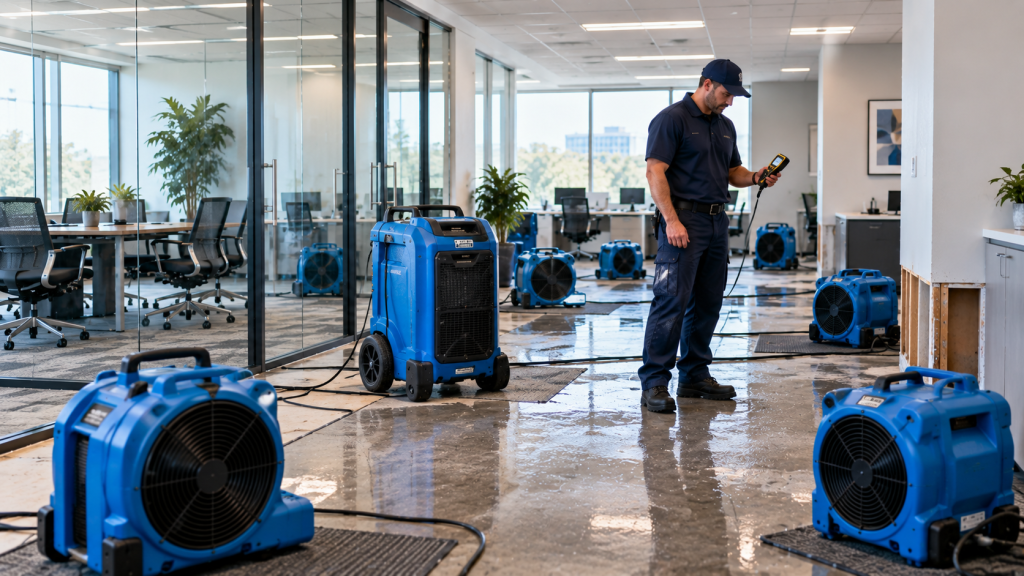
Commercial water damage is any unwanted water intrusion that harms a non-residential building, its contents, its systems or its ability to operate. That definition covers a burst supply line above an office ceiling, a roof membrane that fails during a storm, a sprinkler head that discharges in a warehouse, a sewer backup in a restaurant kitchen and a slow condensate leak that has quietly soaked insulation for months. The water may be clean, gray or contaminated, the affected area may be a single room or several floors, and the damage may be obvious or hidden inside walls and ceilings.
What makes the commercial version of the problem different is scale and consequence. Commercial buildings are larger, have more complex plumbing, fire protection and HVAC systems, and contain more people, inventory, equipment and records than a typical home. Water moves through shared chases, stacked floors, suspended ceilings and open floor plates, so a leak that starts in one tenant space can affect several others. Every day that an area is closed can also mean lost revenue, missed deadlines, disrupted tenants or guests, and obligations under leases and contracts.
This website is a national, educational resource for people who have to make decisions when commercial water damage occurs, or who want to reduce the chance that it does. It explains how damage starts, how it is assessed, what an emergency response involves, how flood and storm water differ from a plumbing failure, how different property types face different risks, and how recovery is planned. It is written for owners, property managers, facility teams, business operators and risk managers across the United States.
A note on scope. The information here is general and educational. Water damage situations differ by building, jurisdiction, policy language and site conditions. Nothing on this site replaces the judgment of licensed professionals, your insurer or legal counsel.
The Most Common Sources of Commercial Water Damage
Most commercial water losses trace back to a short list of sources, and knowing them is the first step toward both prevention and faster diagnosis. Supply-side plumbing failures are among the most frequent: a burst or separated pipe, a failed fitting, a corroded valve or a frozen line that splits when it thaws. Because commercial supply lines are often larger and operate at higher pressure than residential ones, a failure can release a large volume of water quickly, especially if it occurs after hours in an unoccupied building.
Roofs and building envelopes are another leading source. Flat and low-slope roofs common on retail, office and industrial buildings depend on membranes, flashings, drains and penetrations that all age and can fail. Clogged roof drains and scuppers allow ponding, and ponding water finds any weakness. Windows, curtain walls, parapets and below-grade walls also let water in when sealants and waterproofing reach the end of their service life.
Fire protection and mechanical systems contribute more than many owners expect. Sprinkler discharge from a damaged head, a corroded pipe or a freeze can release water across a wide area. HVAC systems generate condensate, and blocked drain pans or lines can overflow into ceilings. Chillers, boilers, water heaters, ice machines, dishwashers and other equipment can leak slowly or fail suddenly. Finally, sewer and drain problems, including main-line blockages and backups through floor drains, introduce a different and more serious category of contaminated water. The causes and assessment guide walks through each source in more depth.
Why Water Damage Spreads and Hides
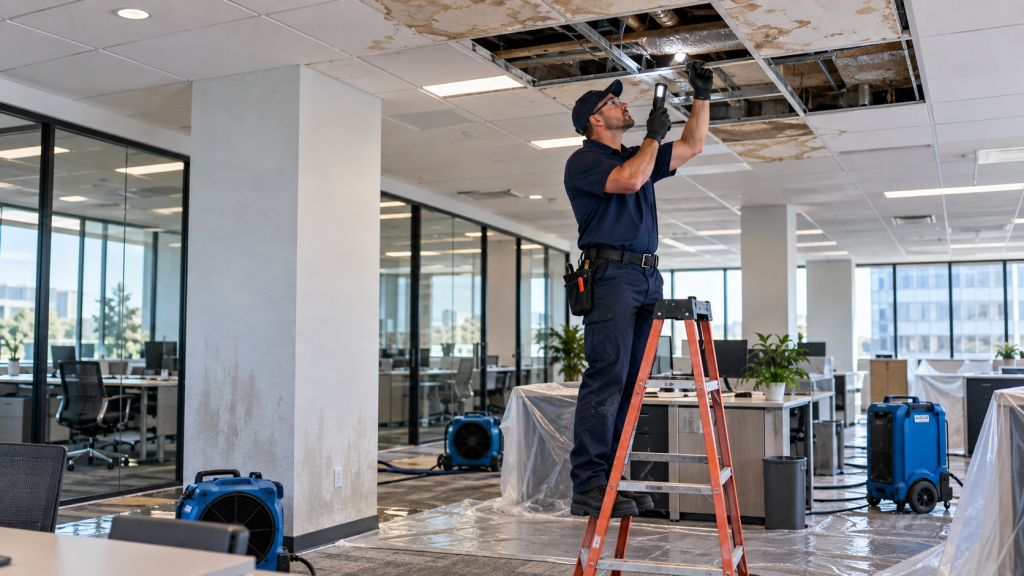
Water rarely stays where it starts. It follows gravity, but it also travels along pipes, wire penetrations, structural members and the tops of walls. In a multi-story building it can move from the point of failure down through floor slabs and into ceilings below. It is absorbed by drywall, insulation, wood, carpet and ceiling tile, and wicks upward and outward from the wet area. The visible stain on a ceiling tile is often only a fraction of the wet materials behind it.
Hidden moisture is the reason a proper assessment matters. Wall cavities, space above ceilings, areas under flooring, insulation and enclosed chases can stay wet long after the surface looks dry. Materials that remain wet for an extended period can deteriorate, lose their finish, delaminate, corrode fasteners and support microbial growth. Environmental agencies such as the U.S. Environmental Protection Agency have long recommended drying wet materials promptly, commonly within a day or two, to reduce the likelihood of mold growth, which is one reason time matters so much in the first stage of a loss.
Humidity is part of the picture as well. A building whose air is saturated with moisture from a leak can cause condensation and dampness in areas that never got wet directly. That is why drying professionals often think in terms of the whole building environment, not only the visible wet spot, and why measuring moisture in materials and air, rather than judging by appearance, is a standard part of good practice.
The First Hours After a Loss
The actions taken in the first hours often shape the size of the loss. The priorities are consistent from building to building: protect people, stop the source if it is safe to do so, address electrical and structural hazards, limit further damage, and document what happened. Occupants should be kept away from areas where water is near electrical equipment or where ceilings and floors may be compromised. If the source can be isolated safely, for example by closing a shutoff valve, that usually comes early. If it cannot, calling the appropriate utility, building engineer or emergency service is the next step.
Once the situation is safe, the focus turns to protecting property and creating a record. Moving or covering contents, removing standing water where it is safe and practical, and contacting your insurance representative and a qualified restoration provider are typical early steps. Photographs and notes taken before anything is removed can be valuable later. The emergency commercial water damage response guide lays out this sequence in a practical checklist and explains what to avoid doing.
Safety comes first. Standing water in a building can be energized, can hide holes or weakened floors, and may be contaminated. Do not enter flooded areas or handle electrical equipment unless a qualified person has confirmed it is safe.
Assessment: Finding Out What Is Actually Wet
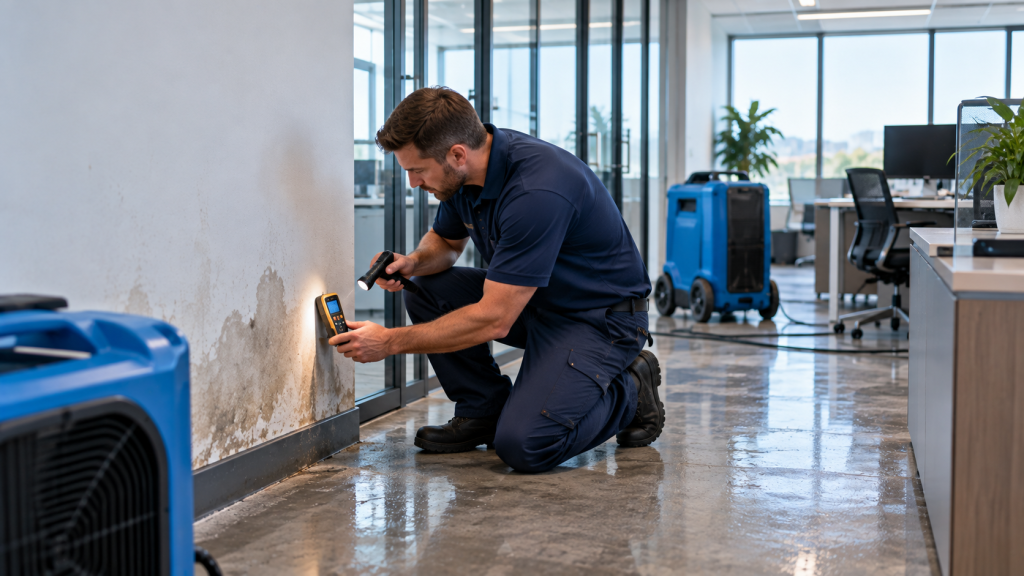
Effective recovery begins with an accurate picture of what happened. A thorough commercial water damage assessment identifies the source and confirms that it has been stopped, classifies the water involved, maps how far it traveled, and measures moisture in affected materials. Professionals commonly use moisture meters, thermal imaging cameras and hygrometers to look beyond what the eye can see, and they record readings so progress can be tracked as drying proceeds.
Assessment also sets the direction for everything that follows. It informs which materials can be dried in place and which are more practical to remove, whether portions of the building can stay occupied, whether specialty trades such as electricians, roofers or plumbers are needed, and what documentation an insurer is likely to request. A rushed or incomplete assessment can lead to repeat work, disputes over scope, or moisture left behind. If you want to understand the method, terminology and common mistakes, read the causes and assessment guide.
Flood, Storm and Sewer Water
Not all water is the same, and the source changes the response. Water from a clean supply line is treated differently from rainwater that has traveled across a parking lot, and both are treated differently from sewage or floodwater that may carry bacteria, chemicals and debris. The widely used ANSI/IICRC S500 standard for professional water damage restoration describes categories of water based on contamination level, and those categories influence which materials can be saved and what protective measures workers use.
Storms and flooding add further complications: widespread regional damage can make contractors and materials scarce, power may be out, building systems may be compromised, and the same event can affect many properties at once. Flood insurance and standard commercial property coverage are frequently separate matters, and the distinctions are worth understanding before an event, not after. The commercial flood and storm water damage guide covers these situations in detail.
How Property Type Changes the Problem
A hotel, a warehouse and a medical clinic can all suffer the same burst pipe and still face very different consequences. Restaurants must consider food safety and health-code requirements. Warehouses and industrial buildings have racking, stored inventory, heavy equipment and large open spans of floor. Medical facilities must protect patients and sensitive equipment and often have strict infection-control requirements. Multifamily and mixed-use properties involve residents, shared systems and several parties whose interests overlap. Schools, hotels, retail centers and office buildings each bring their own occupancy patterns, contents and regulatory considerations.
Understanding these differences helps owners and managers plan realistically. The guide to commercial water damage by property type explains the priorities, common risk points and recovery considerations for offices, retail, restaurants, hotels, warehouses, industrial sites, medical facilities, multifamily and mixed-use properties, schools, campuses and property management portfolios.
Occupied Buildings and Business Interruption
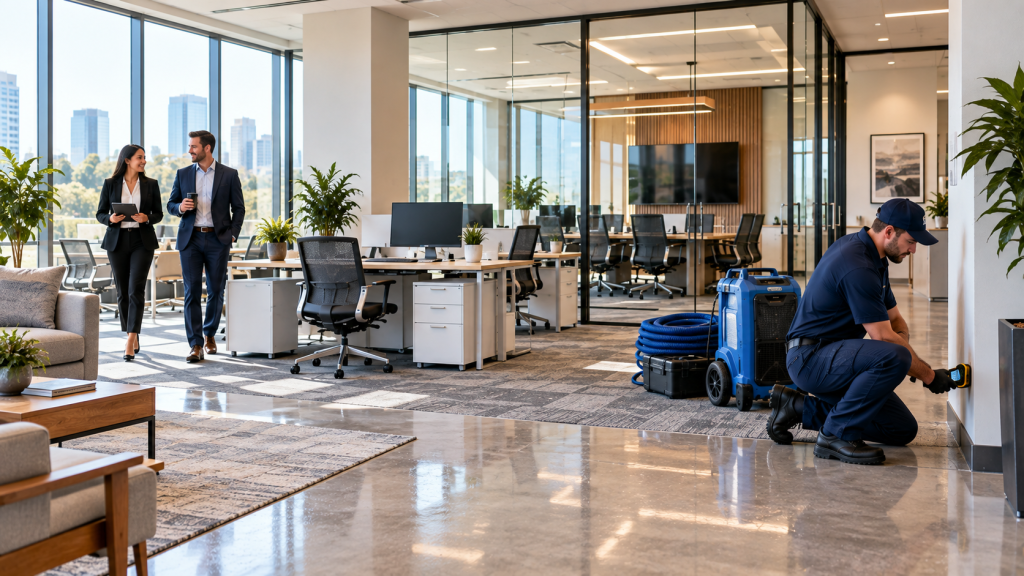
Unlike a vacant property, most commercial buildings are in use when water damage occurs, and some cannot close entirely. Recovery work in an occupied building has to account for tenants, employees, customers, patients or guests. Containment, noise, air movement, odors and access all become part of planning. In some cases part of the building can remain open while drying takes place in another zone; in others, temporary closure is the safer or more practical choice.
Business interruption is often the largest cost of a commercial loss, and it is easy to underestimate. Lost sales, idle payroll, relocation costs, tenant rent abatement and customer goodwill can exceed the direct cost of repairs. Keeping records of downtime, extra expenses and communications with tenants and vendors helps when discussing coverage or lease obligations later. Policies vary widely, and the terms that apply to your property are found in your own policy documents, so it is worth reviewing them with your insurance professional before a loss, not only after.
Planning Recovery from Start to Finish
Recovery is more than drying. A well-run project usually moves through stabilization, documentation, drying, cleaning and treatment where needed, followed by repairs and reconstruction, and finally verification that materials are at appropriate moisture levels before finishes are replaced. Skipping the verification step can result in problems that surface months later, such as odors, staining, flooring failure or microbial growth.
Good planning also includes decisions about who coordinates the work. Owners, property managers, restoration contractors, general contractors, insurers, adjusters and sometimes independent consultants all play roles, and clear communication reduces delays. The commercial water damage planning and recovery guide explains the phases, the documentation to keep, how to evaluate providers, and how to reduce the likelihood of a repeat loss through maintenance and monitoring.
Choosing Where to Start on This Website
If water is affecting your building right now, begin with the emergency response guide. If the cause is unclear or you are trying to understand how far the problem extends, use the causes and assessment guide. If the water came from a storm, flood or sewer, read the flood and storm guide. Owners and managers preparing for the future will find the most value in the property type guide and the recovery planning guide.
Emergency Response
Immediate priorities, safety, documentation and what to avoid in the first 24 to 72 hours. Read the guide
Causes and Assessment
How water damage starts, spreads and is measured, including hidden moisture. Read the guide
Flood and Storm Damage
Storm intrusion, flooding, sewer backups and the water categories that shape the response. Read the guide
Property Types
How offices, retail, hotels, warehouses, medical sites and others face different risks. Read the guide
Recovery Planning
Phases, documentation, provider evaluation and prevention after a loss. Read the guide
Frequently Asked Questions
Commercial water damage is unwanted water intrusion that affects a non-residential building such as an office, store, restaurant, hotel, warehouse, medical facility or school. It can come from plumbing failures, roof leaks, sprinkler discharge, HVAC condensate, storms, flooding or sewer backups, and it often involves business interruption as well as physical damage.
Commercial buildings are usually larger, have more complex mechanical and fire protection systems, and contain more occupants, inventory and equipment. Water can travel through shared spaces and multiple floors, occupancy often continues during recovery, and business interruption, lease obligations and regulatory requirements add layers that a typical home does not face.
As quickly as safety allows. Prompt action limits the spread of water into materials and can reduce the likelihood of secondary problems such as microbial growth. Many guidelines emphasize drying wet materials within roughly one to two days, although actual timelines depend on the materials, the water source and conditions in the building.
Your first priority is safety, including calling emergency services if there is immediate danger. After that, most owners and managers notify their property manager or facility engineer, their insurance representative, and a qualified restoration provider. If the source is a utility line or the sewer, the utility or municipality may also need to be contacted.
It depends on the policy, the cause of the loss and the exclusions and endorsements that apply. Sudden plumbing failures may be treated differently from long-term leaks, and flood and sewer backup are frequently covered separately or not at all unless specific coverage exists. Review your policy and speak with your insurance professional or counsel for guidance on your situation.
Sometimes. Whether a building can remain open depends on safety, the extent of the damage, the type of business, the water category and applicable rules. Recovery teams can often use containment and zoning to keep unaffected areas in use, but that decision should be made with qualified professionals and, where relevant, health or building authorities.
Need to Talk Through a Water Damage Situation?
Use the request form page to outline what happened, the type of property and the level of urgency, so you can organize the information you will need to share with providers and your insurer.