Causes and hidden moisture
Commercial Water Damage Causes and Assessment
Commercial water damage assessment explained: common causes, hidden moisture, moisture mapping and the documentation that supports recovery.
Why Understanding the Cause Matters
Every commercial water damage response begins with two questions: where did the water come from, and is it still coming? The answers determine how urgent the situation is, what kind of water is involved, which trades need to be called, and how the loss is likely to be treated under an insurance policy or a lease. A repair that treats the visible damage but never finds the source simply invites a repeat loss, and a response that assumes the wrong source can waste days.
Causes also shape the scale of the damage. A slow drip from a condensate line may affect a small area for months before anyone notices, while a failed supply line at full pressure can release a large volume within minutes. A roof leak may appear at one ceiling tile while the wet insulation extends across a much larger area. Because commercial buildings are large and compartmentalized, the point where water appears is often far from the point where it started.
This guide explains the most common causes of water damage in commercial buildings, how water travels and hides, and how a structured assessment turns an uncertain situation into a clear picture. It complements the emergency response guide, which focuses on immediate actions, and the recovery planning guide, which focuses on what happens after the situation is assessed.
Plumbing and Supply Line Failures
Plumbing failures are among the most frequent causes of commercial water damage. Domestic cold and hot water supply lines, risers, branch lines, valves and fixtures all operate under pressure, and a failure at any point can release water continuously until the flow is shut off. Common failure points include corroded or fatigued piping, failed couplings and fittings, deteriorated flexible connectors, pressure-related stress, freeze damage and simple installation defects that only show themselves years later.
Commercial buildings have added complexity. Long pipe runs in ceilings and chases, multiple risers serving several floors, and valves that may not be labeled or easily accessible can make isolating a break slower than it would be in a home. Failures that occur at night or over a weekend, when nobody is present to notice or respond, tend to become larger losses because water can run for hours before discovery. Buildings that are only partly occupied, such as multi-tenant offices and retail centers with vacant units, are particularly exposed.
Burst pipes and freeze events
Freezing weather causes pipes in unheated or poorly insulated areas to split, and the damage often becomes obvious only when the pipe thaws and water begins to flow. Exterior walls, above-ceiling spaces near roof decks, loading areas, vestibules and mechanical rooms are common trouble spots. Buildings in regions that do not regularly see hard freezes can be surprisingly vulnerable because their piping is less likely to be protected.
Drain and waste line problems
Drain lines and waste piping introduce a different risk. Blockages, collapsed or root-intruded lines, failed cleanouts and backups through floor drains can send wastewater into a building. This is not clean water, and it is generally treated as a contamination event that calls for additional precautions. The flood and storm guide covers water categories and sewer events in more depth.
Roof, Envelope and Below-Grade Intrusion
Many commercial buildings rely on low-slope or flat roofs, and these roofs depend on continuous membranes, seams, flashings, drains and penetrations to keep water out. Membranes age, seams open, flashings at parapets, curbs and pipe penetrations loosen, and rooftop equipment introduces more places for water to enter. Clogged roof drains and overflow scuppers allow water to pond, and standing water places continuous stress on any weak point. Roof leaks are frequently intermittent, appearing only during certain wind-driven rain events, which makes them hard to trace.
The rest of the building envelope matters too. Curtain walls, storefront systems, windows, sealant joints, cladding, parapet caps and expansion joints are all potential entry points. Water that enters a wall assembly can run down inside the wall before it appears as a stain, and staining at the base of a wall may say little about where the intrusion actually began. Below grade, foundation walls, slabs, elevator pits and stair wells can take in groundwater and surface runoff when waterproofing or drainage fails, particularly during heavy storms or when the water table is high.
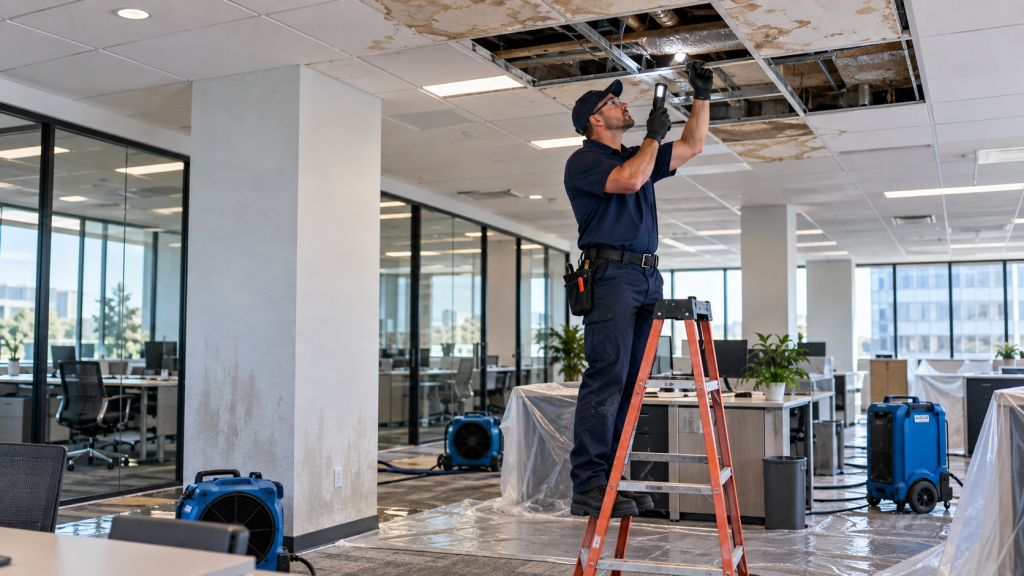
Be cautious with roof access. Roofs can be slippery, weakened by saturated decking or unsafe near edges and equipment. Leave roof inspection to qualified roofing professionals rather than attempting it during or immediately after a storm.
Fire Protection, HVAC and Equipment Leaks
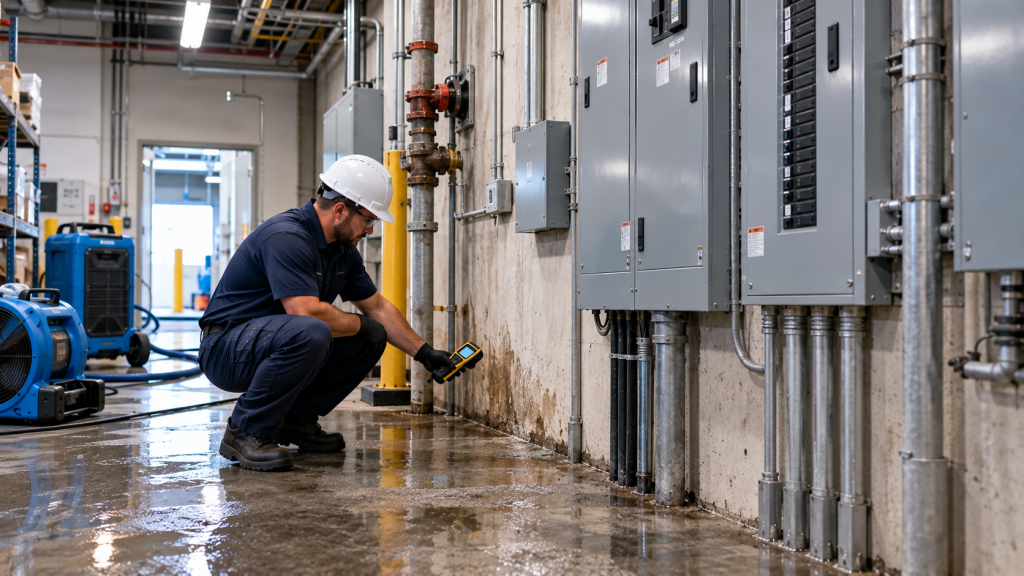
Building systems are a major but often overlooked source of commercial water damage. Automatic sprinkler systems contain water under pressure throughout the building, and a mechanically damaged head, a failed joint, corrosion in an older system or a freeze can cause a discharge that covers a wide area quickly. Sprinkler water is not always clean, particularly in older wet systems where water may have sat in the pipes for long periods, and the response should reflect that possibility.
HVAC systems generate condensate every time they cool the air. Clogged condensate drain lines, overflowing drain pans, failed pumps, leaking coils and poorly insulated cold ductwork can all cause water to appear in ceilings and walls. Chilled water and hot water loops, boilers, humidifiers, cooling towers and heat pumps add more potential leak points. Slow leaks from these systems can go unnoticed for a long time and often lead to persistent moisture, staining and microbial growth before anyone finds the source.
Equipment is another category. Commercial kitchens, laundries, medical and laboratory equipment, ice machines, dishwashers, water heaters, water coolers and process equipment all connect to water supply and drainage. Loose connections, worn hoses, failed valves and overflowing drains cause a steady stream of small and medium losses. Regular inspection and maintenance of these items is one of the most practical ways for facility teams to reduce risk.
How Water Travels Through a Commercial Building
Water follows gravity, but the routes it takes in a building are rarely obvious. It can run along the tops of walls, drop through penetrations for pipes and cables, travel inside wall cavities, move along beams and ductwork, spread under flooring and wick upward into porous materials. In multi-story buildings, water commonly passes through floor slabs and floor penetrations into spaces below, then continues to spread horizontally across ceilings, so the affected area on a lower floor may be much larger than the area where the leak began.
Materials respond differently. Gypsum board, ceiling tile and insulation absorb water readily and can lose their structural integrity or finish. Wood framing, plywood and engineered flooring can swell, warp or delaminate. Carpet and padding hold moisture, and adhesives beneath flooring can be affected. Concrete and masonry can hold moisture for a long time and release it slowly, which can affect flooring installed over them. Metal can corrode, and electrical and electronic equipment can be damaged by direct contact or by humid conditions.
Water vapor adds a further dimension. Warm, humid air moves through a building and can condense on cooler surfaces, so areas that never got wet directly can become damp. This is a major reason that professionals look at the building as a system and measure conditions in the air as well as in the materials.
Hidden Moisture and Why It Matters
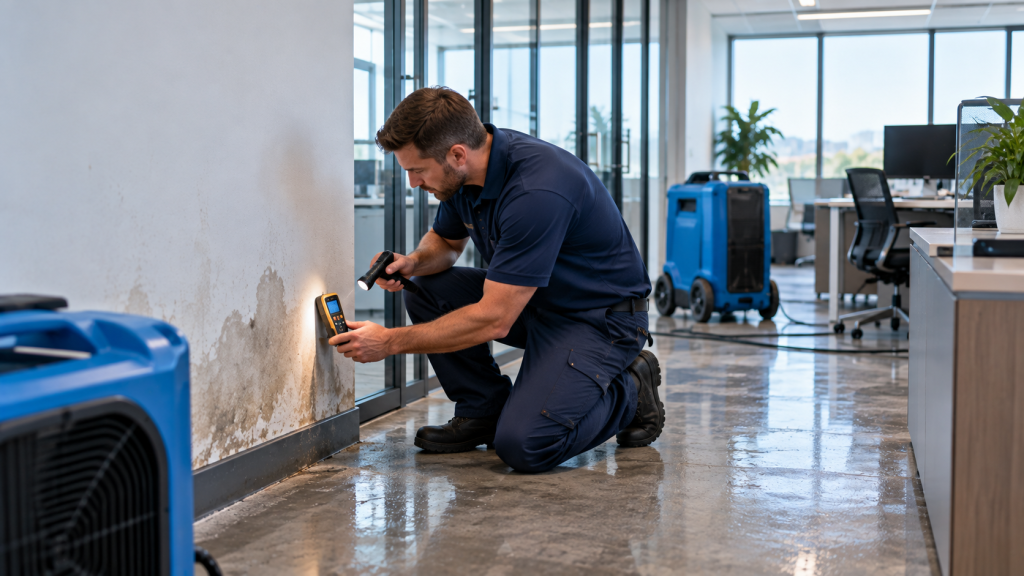
Moisture that cannot be seen is the reason assessment matters. Wet insulation in wall cavities, saturated materials above ceilings, damp subfloors, wet padding under carpet and moisture behind vinyl wall coverings, cabinets or baseboards can all persist after surface materials look dry. When these areas stay wet for a prolonged time, materials can degrade and conditions become favorable for microbial growth, odors and corrosion of fasteners and metal components.
Public health and environmental guidance, including materials published by the U.S. Environmental Protection Agency, generally stresses that prompt drying is important in limiting mold growth. Exact timelines depend on the materials, temperature, humidity and airflow, so there is no universal rule that guarantees a result. What is consistent across guidance is the value of finding wet materials early, measuring them objectively and tracking them until they reach appropriate dry levels.
Signs of hidden moisture that warrant investigation include ceiling staining or sagging, bubbling or peeling paint, warped baseboards, musty odors, visible condensation, efflorescence on masonry, buckled flooring and unexplained increases in water bills. None of these confirms a specific problem on its own, but any of them is a reason to look further.
What a Commercial Water Damage Assessment Involves
A structured assessment turns observation into a plan. While every project differs, the core elements are consistent across well-run responses.
- Stop or confirm the source. The source of water is identified and confirmed to be stopped, isolated or controlled. If it is not, everything else is temporary.
- Make the area safe. Electrical, structural and slip hazards are identified and controlled, and occupants are kept out of unsafe areas.
- Classify the water. The likely contamination level is determined, since that affects protective equipment, materials handling and what can be salvaged.
- Map the affected area. Wet areas are located and recorded, including areas that are not visibly damaged but where water may have migrated.
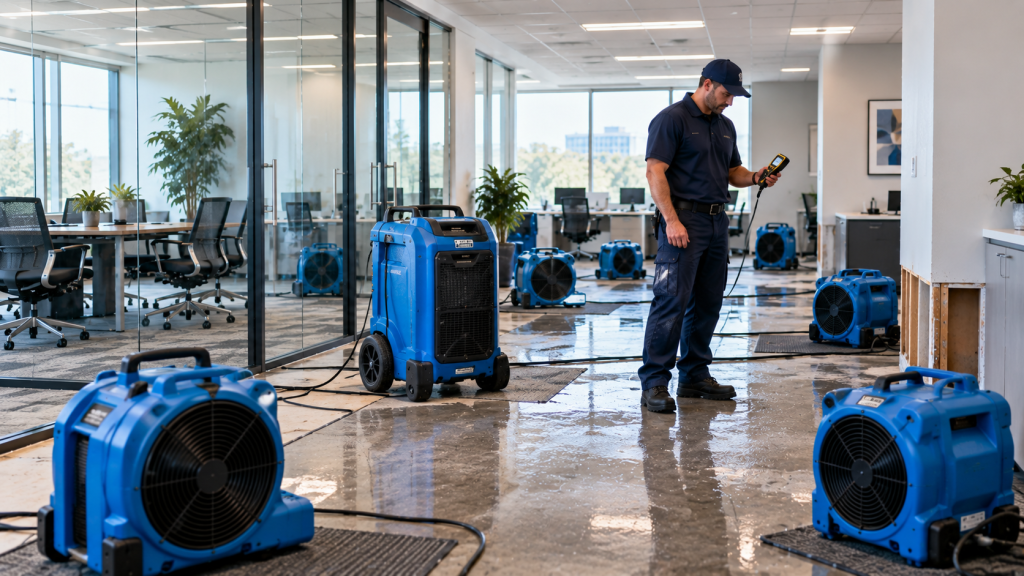
- Measure moisture. Readings are taken in materials and air and recorded so that progress can be verified over time.
- Set the scope and priorities. Decisions are made about what can be dried in place, what should be removed, what can stay occupied and what other trades are needed.
- Document everything. Photographs, notes, readings, sketches and timelines are compiled for the project record and for insurance and lease purposes.
Two widely referenced concepts often appear in this process. Water categories, which describe the contamination level of the source, and water classes, which describe how much material is affected and how quickly moisture may evaporate, are both defined in the ANSI/IICRC S500 standard used across the restoration industry. You do not need to memorize the definitions, but it helps to know that a competent provider should be able to explain how these concepts apply to your loss.
Tools and Methods Used in Moisture Assessment
Assessment relies on measurement instead of appearance. Moisture meters, including pin-type and pinless meters, help estimate the moisture content of building materials. Thermal imaging cameras can reveal temperature differences that may indicate wet areas, though they do not measure moisture directly and are best used alongside meters. Hygrometers and psychrometric instruments measure temperature and relative humidity in the air, which helps assess drying conditions. Borescopes or small inspection openings allow a look inside wall cavities and ceilings without extensive demolition.
Readings are most useful when compared with a reference. Professionals typically record readings in affected materials alongside readings in similar unaffected materials, so that dry standards for the specific building can be established. Regular readings during drying show whether the process is working, and they support the decision to remove drying equipment. Leaving equipment in place too briefly may leave moisture behind, and leaving it in place too long adds cost, so verified readings help owners avoid both.
Some situations call for additional specialists. Complex leaks may require leak-detection technicians, plumbers, roofers, mechanical contractors or building envelope consultants. Suspected microbial growth, asbestos-containing materials, lead-based paint or other regulated materials may trigger additional testing and rules that vary by jurisdiction. When these concerns arise, involve qualified and, where required, licensed or certified professionals.
Documentation That Protects You
Documentation is part of assessment, not an afterthought. Photographs and video of the affected areas before anything is moved, notes on when the water was discovered and by whom, records of when the source was stopped, lists of damaged contents and equipment, and copies of communication with tenants, vendors and insurers all become important later. Readings, drying logs and daily progress reports create an objective record of what was done and why.
Keep the record organized and stored somewhere accessible outside the affected building. Many owners find it helpful to designate a single person to maintain the file so that information is not scattered across email accounts and phones. This practice also makes discussions with an insurer or adjuster more straightforward, because the timeline and scope are supported by evidence. Coverage questions, including whether a particular cause is covered and how a claim is valued, depend on the policy itself and should be discussed with your insurance professional or legal counsel.
Occupied Buildings and Assessment Priorities
Most commercial buildings remain in use when a loss occurs, so assessment must consider the people and operations in the building. Tenants, staff, customers, patients or guests may need to be relocated from affected zones. Critical functions such as data rooms, laboratories, pharmacies, kitchens and life-safety systems may need to be protected or kept online. Coordination with tenants and building management reduces confusion and helps limit business interruption.
Assessment can support zoning decisions, meaning which parts of the building are unaffected and can stay open, which are affected and need containment, and which require restricted access. Noise, air movement, odors and equipment placement all affect people nearby, so communication about schedule and access is part of good project management. Where health, fire or building authorities have requirements, such as in food service, health care or education, those requirements come into play early in the process.
Common Assessment Mistakes to Avoid
Several mistakes appear repeatedly in commercial water losses. The first is judging the extent of damage by the visible stain alone. The second is treating the surface without locating or confirming the source. The third is assuming water is clean when it may not be, particularly when it has passed through ceilings, insulation, floor drains or older piping. The fourth is failing to document conditions before cleanup begins. The fifth is ending drying based on how materials feel or look instead of on measured readings.
Other common problems include delaying the involvement of the insurer, discarding damaged items before they are recorded, allowing unqualified personnel to work around electrical hazards, and neglecting communication with tenants and occupants. Avoiding these mistakes does not require technical expertise from the owner, only a habit of asking clear questions and expecting clear, measurable answers from the professionals involved.
Continue: Emergency Response
What to do in the first 24 to 72 hours after a commercial water loss. Read the guide
Continue: Flood and Storm Water
Water categories, storm intrusion and sewer events. Read the guide
Continue: Recovery Planning
Drying, repairs, documentation and provider evaluation. Read the guide
Frequently Asked Questions
Common causes include plumbing and supply line failures, roof and envelope leaks, sprinkler discharge, HVAC condensate problems, equipment leaks, storm intrusion, flooding and sewer or drain backups. The most frequent cause varies by building type, age, climate and maintenance practices.
They combine visual inspection with moisture meters, thermal imaging, humidity measurements and, when appropriate, small inspection openings. Readings are recorded and compared with unaffected reference materials so that the extent of wet areas can be mapped and progress tracked during drying.
Categories describe the contamination level of the water source, from relatively clean to grossly contaminated. Classes describe how much of the building and its materials are affected and how easily moisture can evaporate. Both are defined in the ANSI/IICRC S500 standard and influence the scope and methods of a response.
Yes. A slow leak can saturate insulation, framing and finishes over time and remain hidden until staining, odors or material failure appear. Long-term leaks may also be treated differently from sudden losses in an insurance context, so consult your policy and your insurance professional.
Sometimes, but not always. Non-invasive tools can often guide where limited openings are worthwhile. The decision depends on readings, the materials involved and the risk of leaving moisture behind, and it should be made by a qualified assessor.
A qualified restoration professional, and, where the cause is unclear or complex, specialists such as plumbers, roofers, mechanical contractors or building envelope consultants. Ask providers to explain their methods, show readings and provide written documentation of findings.
Need Help Organizing Information About a Loss?
Use the assistance page to outline the source, the affected areas and your timeline, so that assessment, documentation and insurer conversations start from a clear record.